Sunderland AFC 1966/67
___________________________________________________
The season started with 3 defeats from the first 4 games and to be honest it was another topsy-turvy campaign. There were however some highlights. On 31 December 1966 a Scots lad, discovered by Charlie Ferguson, made his full Sunderland league debut at home to Manchester City. He scored the only goal of the game. His name was Bobby Kerr. Little did we know then but some 6/7 years later he would make history for Sunderland AFC. He had been substitute in the last 2 games, and with Kerr in the squad we lost only 1 out of 11. Injured for the away game at Stoke City, we promptly lost, and indeed lost 7 out of the next 11. That we played without Kerr was a tragedy, but it wasn’t the Managers fault. The midfield maestro, as he would become, had a baptism of fire when he broke his leg against Leeds United on 11 March at Elland Road, in an FA Cup replay. In fact his luck wouldn’t get any better. In his comeback game for the reserves, he broke his leg again and was absent from first team duty for 18 months. Football is a tough and cruel game as a young Bobby Kerr found out. The FA Cup witnessed one or two memorable games. The 3rd round got us off to a flyer with a 5 v 2 thrashing of Brentford, before a tricky tie at home to Peterborough United. Tricky? Well not quite, Sunderland won 7 v 1, with Neil Martin scoring a hat trick and Kerr notching a brace. That set us up nicely for a 5th round clash with Leeds United. There was extra spice to this game as Willie McPheat had broken his leg at Elland Road 4 seasons previous. The first game at Roker Park was played out in front of 55,763 fans. Ending 1 v 1 the Elland Road replay would draw a record crowd for the Yorkshire club. The 11 March game saw 57,892, with some 20,000 from Wearside, packed into the stadium and all hell broke loose when the crowd spilled onto the pitch from obviously overcrowded sections. Sunderland again took the lead, this time through John O'Hare, but the Leeds side equalised. The second replay took place at Boothferry Park, home of Hull City. This time United took the lead, with Sunderland drawing level in the last quarter of an hour through Alan Gauden. With seconds to go Cecil Irwin was penalised in the box and Johnny Giles scored from the resultant penalty. Not content with this piece of bad luck both Herd and Mulhall were sent off for persistent complaining, the penalty decision looked harsh. In reality Jimmy Greenhoff had been standing a mile offside, before being fouled. Even the Leeds United President, Lord Harwood acknowledged his teams luck. On 4 March 1967 the local Roker Park derby against Newcastle United took place. That the first team would win 3 v 0 was good enough, that the supporters also beat the Magpies in a friendly match that day was double cause for celebration. The red and whites won 4 v 1. This continued our domination of supporter’s matches, now 5 victories in 9 matches to NUFC's solitary victory. The compensation for relegation in 1958 was an excellent youth structure, put in place by Alan Brown. This paid dividends with Sunderland defeating Birmingham City in the final of the FA Youth Cup. That Brian Clough was manager of the youths was ironic, and showed even then what his man management skills were. If only we knew then what we know now...things could have been so much different. The highlights for the Youths were the performances of Chester-le-Street’s Colin Todd and Colin Suggett. Both had been magnificent. But the triumph was not only down to Clough and Brown, the talent spotting of chief scout Charlie Ferguson had been central to the success. Sunderland would win the trophy again in 1969. In the end 17th was poor, but the club and the players couldn’t go on holiday yet as Sunderland AFC, for one summer at least, became known as The Vancouver Royal Canadians. |
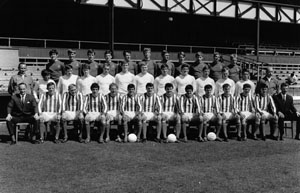 With the world cup now over the Sunderland fans hoped for a better season. That we ended up a "comfortable 17th" was little to shout about, and whilst our home form was fair, away from Wearside we were awful.