
Sunderland AFC 1959/60
___________________________________________________
The opening game of the season was at Stoke City’s Victoria Ground, where we succumbed 1-3. A home win over Villa midweek was followed by a disappointing 0-0 draw with Brighton. The return against Villa ended in defeat, and it was then with some trepidation, bearing in mind our 0-5 Vetch Field defeat of the previous campaign, that we headed for Swansea. We needn’t have worried as we triumphed 2-1, with a 21st minute Griffiths own goal sending us on our way. A 2-2 draw at Roker with Bristol Rovers on 12th September, owed much to Colin Grainger’s last gasp equaliser, that made the referee’s final whistle inaudible, the crowd were still cheering. This was followed up by a comprehensive annihilation of Sheffield United 5-1 in which 19 year old youngster Lawther had a fine game. The next match was a debacle, 1-6 at Ipswich in which 2 Town players scored hat tricks. Inside right Curtis and inside left Phillips, the last from the penalty spot. Ambrose Fogarty got the scant consolation goal for Sunderland. two draws then followed, before a 3-0 floodlit friendly win against Winterthur. The same day as the friendly match the Football Association had applied for a stay of action for damages in respect of the “Mr. Smith affair”. Heard at the Chancery Division in London five Sunderland players Elliott, Fraser, Hannigan, Chisholm and Daniel had all contested bans handed out in 1957. Gerard Gardiner QC, acting for the players started by talking about “the Gestapo like tribunal”. The hearing was adjourned until 9th October. Some eight days later and Derby County were defeated 3-1. This was Sunderland’s first Saturday home win of the season and once more Grainger scored a late goal. Hannapi and Rapid Vienna then visited in an entertaining 5-2 victory for Sunderland. Onto 24th October 1959, and due to an injury to King Charlie Hurley, Martin Harvey saw his first taste of league action at the tender age of 17. Sunderland drew with Plymouth Argyle at Home Park 0-0. The game was brightened up by a 50 strong contingent of the bugles and band of the Durham Light Infantry stationed at Honiton. We now entered a dark patch where we suffered 7 defeats in 11 games and didn’t taste league success until 16th January, nearly two months after the 14th November Bristol City success. One of the defeats was at Scunthorpe and The Old Show Ground. United had tasted defeat on their own patch only once so far that season. Perhaps the worst defeat however was at home to Rotherham United. It smashed our unbeaten home record that had stood since 13th December the previous year. Home crowds were now alarmingly low, with the game against Stoke City attracting only 12,221 hardy souls. The previous low was against Brighton, a crowd of 12,024 witnessed the end of season 4-1 win. The Lincoln City defeat on Boxing Day, was not only a Christmas present that nobody wanted but meant that Sunderland had lost six on the trot. During this time we were also knocked out of the FA Cup by Blackburn Rovers after a replay at Ewood Park. O’Neill had been sent off in mystifying circumstances in the first game at Roker Park. A friendly game at home to Glasgow Celtic resulted in a comprehensive 7-1 rout of the Scottish giants. The Scots were by no means weakened and featured the Scottish captain Evans and Ireland’s centre half Peacock. Sunderland had led 5-1 at half time. Our home form was now worrying and the defeat by Leyton Orient 1-4 was our sixth in seven games. Things improved marginally with a 2-2 home draw against Middlesbrough. It was 13th attempt lucky for Sunderland at the Baseball Ground following 12 successive league and cup away defeats, our last travelling success had been 7th September and Bramall Lane. A hat trick by Sunderland born Alan O’Neill contributed to a 4-0 rout of Plymouth Argyle, finding life tough back in the Second Division, his third being slammed into the net after a mazy run which had taken him virtually the entire length of the field. He was not so lucky in the next game at Millmoor where a 1-0 defeat was further marred by a heavy tackle by Rotherham’s Madden, resulting in a badly injured right knee. We fell apart against Charlton and Bristol City, with ex England man John Atyeo proving a handful, then as if to prove that the roller coaster was alive and well won the next two. With six league games to go we weren’t sitting pretty in the table, but relegation was only a faint possibility. The game on 9th April 1960 was special, marking the debut of one Nick Sharkey. Just days short of his 17th birthday he featured in a Sunderland side which beat Scunthorpe United 1-0, the lone goal scored by Ambrose Fogarty. Relegation worries were eased after a 2-1 win on the south coast against Portsmouth at Fratton Park. The last home game of the season was a disappointing 0-0 with Cardiff City. Three away games later, and we had one win, at London Road. The Liverpool game at Anfield had seen the Livers triumph to earn third place and £60 “talent money”. It meant that Sunderland hadn’t won at Anfield since before the war, a dismal record. Sunderland then travelled to Winterthur for a return game, in which the Swiss gained revenge for the 0-3 reverse in October by defeating the Lads 2-1. We did however miss a penalty in each half, much to the delight of the 3,500 crowd. Anderson and Taylor the culprits. Syd Collings became chairman at the end of the season, having been on the Roker Park board for some 13 years. He had also been on the Football League Management committee and a member of the England Selection Panel from 1963 until 1966. |
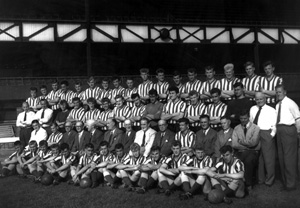 The season was a nadir for Sunderland. We ended 16th in the Second Division, our lowest placing ever and “amassed” only 36 points. We scored only 17 goals away from home, our lowest total since 1921/22.
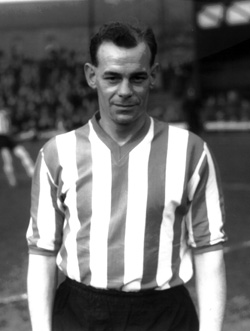 The home defeat by Ipswich was self inflicted, as the normally reliable Ernie Taylor (pictured right) missed a penalty. This was followed by a trip to Leeds Road and a five star performance from a rising star, a certain Denis Law. Newspapers of the day report that he was a “Law unto himself” and it was fitting that he should score Town’s goal in the 1-1 draw. He looked every inch the £40,000 transfer target that he was.