
Sunderland AFC 1955/56
___________________________________________________
If the season had a turning point it was probably a friendly match that fazed us this time, and yet again it was a case of so near and yet so far. The championship was definitely on at one stage of the season, but we just inexplicably collapsed. The campaign started with a glut of goals and surprisingly a 1-3 defeat by Cardiff City at Ninian Park. Too much “individualism” was given as the reason; too many stars perhaps? Then we crashed in 13 goals in three league games. Aston Villa were wiped out 5-1, Huddersfield Town defeated 4-1 and Villa again, this time at Villa Park, were found out 4-1. The goals were evenly shared between six players; Shack of course was one of them. At the beginning of September we went to Blackpool and lost 3-7. Having scored the first goal, McDonald the Sunderland left back then wrenched his knee and with no substitutes in those days he was a virtual passenger for the rest of the game, and played in attack. This necessitated a reorganization of the whole team and in doing so we went to pieces. Mortenson and Matthews had a field day and ran riot. At one stage we were 1-7 down! Still we pulled our socks up and won the next three games including 4-3 against Chelsea, having trailed 0-3 after 27 minutes. The victory against Arsenal at Roker Park saw the Gunners prop up the table, a position they are not accustomed too. The Lads even took the liberty of missing a twice taken penalty; Anderson the culprit. Come the 23rd October and Sunderland travelled to Paris to play Racing Club and won a stormy match 4-3. With Shackleton scoring two to give the Lads a 4-2 lead Ted Purdon was kicked as he lay on the ground injured. A fight then broke out between the French goalkeeper and the Sunderland forwards, which incensed the crowd so much that some of them invaded the pitch. The rest of the match was played in an eerie atmosphere of police patrolling the perimeter. Onto 2nd November and First Vienna arrived on Wearside and at 0-4 down with only 30 minutes played it looked like the visitors were in for a hiding. Then a fight back by the Austrian champions made the score 4-4, and they maintained their unbeaten run against English sides. A crowd of 31,629 were gobsmacked. By the time Moscow Dynamo arrived on Wearside on 14th November Sunderland were going great guns and the championship was definitely on. It should be appreciated that the Russians were probably the greatest club side in the world at this time and contained of course the legendary goalkeeper Lev Yashin. The game was in truth a disappointment and it was a goal four minutes from the end that settled the affair. Bingham had hit a post earlier in the game, but that was as near as we had come. For some reason this defeat signalled the demise of Sunderland, and in our very next game we capitulated horribly 2-8 at Kenilworth Road. Luton had been newly promoted that season and had already dished out a 5-1 hiding of Wolves. The red and whites arrived at the Town as league leaders, and with no apparent injury worries it was a complete mystery why we should be beaten so heavily. In eight league games before the end of the year we won only two. The Christmas and New Year period was miserable as we slumped to two defeats by Newcastle United. First of all at Roker we succumbed 1-6 then at St James we crashed 1-3. Sounds very much like the stuff nightmares are made of. The Christmas Eve game saw 19 year old Derek Weddle make one of only two appearances for Sunderland as a replacement for centre forward Ted Purdon, out of sorts. The funny thing was that he was on leave from the Northumberland Fusiliers at the time, serving two years national service. Sunderland signed Bill Holden from Burnley, but he had little impact. From the Moscow game we played 27 league games and conceded an amazing 66 goals. The FA Cup run basically saw us fold in the league. January 7th and Norwich City in round three witnessed a 4-2 victory. Sunderland should have run up a cricket score but somehow contrived to be 1-2 down after 45 minutes. Still three goals in the first 17 minutes of the second half sealed a fourth round date with York City. The first game at Bootham Crescent saw the Minstermen rampaging forward for over an hour. Having succumbed to defeat at Roker Park at the hands of Newcastle United, in last season’s FA Cup semi final the City side made their way once more to Wearside after a 0-0 draw, their second visit in 10 months. The red and whites found this game far from easy and it took an 87th minute Charlie Fleming goal to ease us through. The fifth round and we were drawn to play at Bramall Lane, home of Sheffield United on 18th February. Once more it ended goalless, although Burgin the Blades goalkeeper had to be at his best in the closing stages to keep Sunderland out. Four days later and a magnificent 35 yard drive by Daniel, with just eight minutes remaining, saw us home. You’ll never guess who we drew in the sixth round; Newcastle United, at St James’ Park! This was the first Tyne/Wear cup game for 43 years and Sunderland triumphed 2-0 with the Bolton born Bill Holden scoring a brace for us. Strangely enough Holden had made his red and white debut against Newcastle on 27th December and scored our only goal that day. Billy Elliott though was the star. “If we get past the sixth round next year I think they’ll have to give us a bye straight into the final,” was Len Shackleton’s quip after Sunderland’s 17th March FA Cup semi final defeat by Birmingham City at Hillsborough. This was the ninth time Sunderland had made the last four and as we have seen only 1913 and 1937 saw them make the final itself. An attendance of 65,107 watched Sunderland succumb to defeat, and in truth right from the start it had been an uphill struggle. City took the lead as early as the ninth minute and from there on never looked back. The first goal was technically an own goal by McDonald although Govan had done all the spadework. Astall made it two on 65 minutes, before Brown wrapped it up with seven minutes to go. Erick in The Blues goal was outstanding and it was evident that it wasn’t to be Sunderland’s day, right from his first blinding save. The Birmingham fans chanted “the end of the road” at the departing Sunderland fans. How apt; it was the end of the road, for 12 months at least. Sunderland then won only one out of the next seven league games, including a right hiding from Burnley 0-4. One week later we gained our only win in that streak when we triumphed over Tottenham Hotspur 3-2. Charlie Fleming scored twice, and in doing so moved into second place in the First Division’s goalscoring charts. Two defeats on the trot at Maine Road and the Valley made it four defeats in the last five league games... depressing. The 11th April saw a floodlit victory over Airdrie 1-0, with who else but Fleming scoring the goal. So we entered the last four games of the season with little to play for. A season that had started so well, finished so tamely. What a shame. The penultimate game of the season saw Sunderland inflict their third defeat of the season on Sheffield United, and in doing so virtually “cooked The Blades’ goose” as far as their stay in the First Division was concerned. In 1956 Sunderland, mindful of his talent and display a few months earlier, tried to sign Hanappi the majestic Austrian, but his FA blocked the deal. One wonders what the impact would have been had he arrived on Wearside. Born in 1929 Hanappi would succumb to cancer at the age of 51 and die in 1980, having won 96 international caps. A tragic end to a brilliant career, glimpsed fleetingly by the Roker Roar. From 1954 to 1960 Hanappi won all seven Austrian Player of the Year titles. The season ended with a four game trip to Israel. |
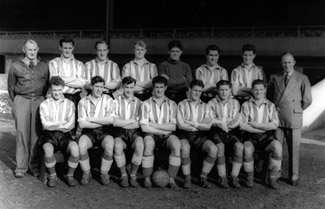 The 1955-56 season proved to be a carbon copy, cup-wise, of the previous campaign, although this time we slumped to 9th position in the league. Sunderland again made it to the semi-final stage of the FA Cup after a resounding victory over Newcastle United at a packed St James’ Park. Our opponents were Birmingham City, but the end result was the same, another last four exit of the competition.