
Sunderland AFC 1954/55
___________________________________________________
Watson didn’t play that season and eventually left for Halifax town on 5th November 1954. January 1955 saw the arrival of Charlie “Cannonball” Fleming, a deal which incidentally saw Tommy Wright going in the opposite direction to East Fife. The main success of the league campaign had been based around a solid defence. Stan Anderson in particular had been a revelation, taking over from Watson. Fraser had also done well in goal. The season started in fine style. The opener against West Bromwich resulted in a 4-2 victory. The Baggies were cup holders, league championship runners up and Sunderland had injury worries. Most significantly, with goalkeeper Fraser unable to get leave from the army, Throckley born Leslie Dodds, just 17 years of age, took over between the sticks. It couldn’t have been more nerve wracking for the “kid” with over 56,000 packed into Roker Park. A draw at Villa Park was followed up by a 1-0 triumph at White Hart Lane. The latter result was even more impressive when you consider that the Lads were effectively down to 10 men for most of the game, after Chisholm had sustained a shoulder injury in a clash with Ditchburn. Purdon scored the winner on 36 minutes. By the end of September we had played 10 league games and lost only one, at Wolves on 8th September. One of our triumphs was against Charlton Athletic 3-1, our first ever success at The Valley. The 2-0 triumph over Blackpool saw Sunderland score twice in 80 seconds and witnessed the demise of England legend Stan Mortenson. He looked a pale shadow of his former great self. Into October and a 1-1 home draw with Bolton was followed by the Tyne-Wear derby with Newcastle United on Wearside. Not only did Sunderland win, 4-2, but in doing so they went to the top of the table in front of 66,654 fans. McDonald and Bingham starred for Sunderland. October and November saw us play a string of floodlit friendlies. In front of 16,077 Sunderland played Falkirk and in defeating us 3-2 the Scots became the first team in the season to score that many goals past us. Then it was the turn of Borussia Dortmund who arrived on the 18th October. In an absorbing game the Germans were defeated 3-2. Danish “touring side” Stoevnet, made up of players from the three Copenhagen outfits were thrashed 4-1 and a 10th November match against Edinburgh giants Heart of Midlothian ended 3-3. The 1954 friendlies ended with a visit to Clyde, and Shawfield Stadium, who defeated us 1-3. By this time we were going great guns in the league and by the New Year had suffered just three defeats. One of the defeats was at Everton, and in truth we were unlucky. Having given as good as we got for the match we succumbed to a sucker punch with just 11 minutes remaining, in front of 60,000 at Goodison Park. Against Sheffield United we scored after nine minutes, lost the plot completely and had to scramble an 87th minute equaliser to preserve our unbeaten home record. In defeating Arsenal 3-1 at Highbury Sunderland maintained their phenomenal record in London, they hadn’t lost in the nation’s capital for 15 months. One of the main reasons why the Lads didn’t secure the championship in the season was the fact that we played far too many draws at Roker Park. By the time the 20th November game against Burnley was over, a 2-2 draw, we had been held no fewer than six times in the first 10 Wearside games. We ended up drawing 11 in total. There was a milestone for Len Shackleton in the home game with Manchester City on 4th December. Whilst devastatingly brilliant in the 3-2 victory he also gained the distinction of having played 250 league games for Sunderland. Two weeks later and Sunderland travelled to The Hawthorns, knowing that a win would see them top of the table with Wolves. We played brilliantly for 35 minutes, collapsed, ended up drawing and missed out. Still going into the Christmas/New Year period we were breathing down the necks of the top dog. The Christmas fixtures were against Huddersfield Town, and both games ended 1-1. A third such scoreline was recorded when Spurs visited before it was FA Cup time again. This would be a brilliant campaign and in the end we would make the semi final. Billy Elliott made 40 league appearances and seven appearances in the FA Cup for the club scoring a crucial only goal in the third round against Burnley in front of a 50,108 attendance at Roker Park. Preston were defeated at Roker, 2-0, after a thrilling 3-3 draw at Deepdale. Many thought this worthy of the final itself. The game in Lancashire had seen Tom Finney limp off with 10 minutes to go after pulling a thigh muscle. The England maestro had opened the scoring. All six goals came in a half hour spell. The replay saw over 70,000 people turn up, and more than 10,000 were turned away. Swansea Town at the Vetch Field witnessed a tough and uncompromising game as the teams battled it out for a 2-2 draw. This game incidentally featured the Allchurch brothers, the most famous of whom was of course Ivor. The replay was watched by nearly 40,000 people, who paid gate receipts of some £5,943. The Lads narrowly triumphed 1-0. Wolverhampton Wanderers, trying for a league and cup double, were put to the sword at Roker, 2-0. Purdon scored both goals, the second just three minutes before the end, but Wolves had been handicapped by the loss of Bill Shorthouse, their left back, with concussion, after an early clash with Billy Bingham. Before you knew it Sunderland were at Villa Park for a waterlogged eighth semi final encounter against Manchester City, our first such game for 17 long years. The game was lost however 0-1 and a potential North East final with local neighbours Newcastle United “avoided”. The lone goal was scored by Clarke, and in truth it was rough justice on Sunderland, who deserved to win. City hung on by the skin of their teeth, having been down to 10 men for the last three minutes when the goalscorer was carried off. The match in truth should never have taken place, the pitch was horrendous, but with nearly 60,000 in the ground the correct decision was taken. A similar tale unfolded for the league game at Roker against Sheffield Wednesday in the January. A partial thaw had left the ground in such a state that it was a surprise to many when the referee, a Mr Sherlock from Sheffield, declared the pitch playable, just two hours before the scheduled kick off time. February 12th witnessed our first home defeat in 10 months when Charlton travelled to Wearside and rumbled us 1-2. Having beaten Newcastle at home 4-2 we travelled to Gallowgate towards the end of February and defeated the Magpies 2-1, with Charlie Fleming scoring both goals, one in the dying seconds of the game. The FA Cup campaign had fazed us and our league form suffered. In between the 5th round and the semi final we lost three crucial games. Coupled with our home draws we now see how we missed out on a seventh championship. By the end of March Chelsea were the new league leaders, and in April Sunderland defeated Manchester United 4-3 at home, with Ken Chisholm scoring a hat trick of headers. The season ended with our biggest home win of the season, 3-0 over Everton. This assured us fourth place, when it truth it could so easily have been the league championship. To end the season Sunderland undertook a gruelling nine matches in a month-long tour of North America. In total we would win five and draw four. The first three games took place in New York, one in Brooklyn where the American League representative side were hammered 7-2, Huddersfield Town succumbed 3-2 and Nuremburg managed to hold us 1-1. Onto Philadelphia and a 3-1 victory, before we returned to New York, hammering an American All star team 4-1. Crossing into Canada Montreal were beaten on their own patch 4-2, Huddersfield Town drew 3-3 in Winnipeg, with two further ties in Toronto and Detroit against the past Yorkshire giants. The annual report showed that receipts for the season were an all time record at £104,188. Players’ wages totalled just over £34,000. The cost of players this season was just £1,869 compared with £74,957 the previous campaign. The annual meeting was held on 6 July with Messrs Collings and Parker presenting themselves for re-election, in accordance with the Club’s Articles. |
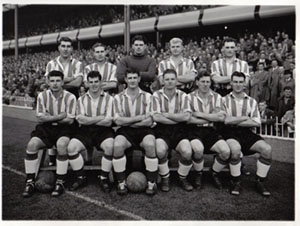 1954-55 was Sunderland’s last successful season in the top flight. The season had produced 18 drawn games, the highest ever in the history of the club. This record would be equalled in 1994/95. This was Willie Watson’s final season with Sunderland and fourth position was just reward for a hard campaign. Indeed but for a few more goals it would have been second.