
Sunderland AFC 1953/54
___________________________________________________
There was much interest due to the now famed Bank of England status. With the stripes leading 4-2 at half time, Ford and Shackleton went crazy in the second half and contributed greatly to a final score of 8-6 victory to the whites. Ford scored five times. The 1953/54 campaign began with nine signings involving a total transfer outlay of some £70,000. In dubbing Sunderland as the Bank of England Club many wished ill of Sunderland. Such financial clout was considered by many to be excessive and harmful to the game. One of the names tried for was Newcastle United’s Jackie Millburn who had “suffered at the hands of the NUFC directors”. He was interested in a move to Sunderland; it would enable him to be near his good friend Len Shackleton. In the end the Magpies’ board turned down Sunderland’s approach and the rest as they say is history. Nevertheless with Goalkeeper Jimmy Cowan arriving from Morton, centre half Ray Daniel from Arsenal and Billy Elliott from Burnley, these three international players were supposed to signal the end of the “slump” on Wearside. Ted Purdon arrived from Birmingham City, Joe Macdonald from Falkirk. The wholesale change proved disastrous. Sunderland quite simply flopped and ended in 18th position conceding 89 goals, a club record. It didn’t stop there. Humiliation was complete when dumped out of the FA Cup by Doncaster Rovers. Of the big signings only Billy Elliott really did himself credit, indeed Willie Fraser, signed from Airdrie would end the season in goal, with Cowan, unable to settle, transferred. Ken Chisholm settled well after signing from Cardiff City. There were some memorable moments, in particular the 7-1 thrashing of Arsenal, in which Trevor Ford chalked up a hat trick. Midway during the season however, Sunderland were bottom of the table, defensively they were in tatters. It got worse as Ford went to Cardiff City for £30,000. The season had started in terrible fashion, with four defeats in the first five games. In two of the matches, against Charlton and Manchester City, we conceded five goals. And yet in that period we scored 12 times ourselves, but only had two points to show for it. The 12th September thrashing of The Gunners was about the only time all season we “got it right”. Sunderland’s “routing” of The Arsenal included scoring five times in 22 minutes. Against Blackpool the red and whites were 1-2 down with only four minutes to go. Goals from Daniel and Ford resulted in a 3-2 victory. The Tangerines could scarcely believe it when they left the field. At Stamford Bridge Sunderland led Chelsea 2-0 with just 30 minutes left, and looked on course for their first away win in 11 months. The Blues scored twice to force a draw. The pleasures of floodlit football were spreading and on 5th October Sunderland were invited to West Ham United and the Boleyn Ground for the inaugural match under the new equipment. We lost 0-2. Racing Club de Paris were entertained on 21st October and once more Amalfi played in a 5-2 Sunderland win. This time he played well, but was taken off early due to an injury he sustained in a previous game against Spurs. By the end of October we were in real trouble, rock bottom of the league. The penultimate game of the month had resulted in a 2-6 hammering by Preston at Deepdale, in what one member of the press described as the “worst display I have ever seen from them.” The beginning of the November saw the Austrian maestros Rapid Vienna at Roker Park. The legendary Hanappi stole the show with a magnificent exhibition that had the Sunderland faithful on their feet in appreciation. The visitors won 3-2 and in truth everyone enjoyed the match, even though the Lads lost. Over 33,000 wit nessed the match, and as well as Hanappi scoring the Vienna goalkeeper was Zeman, who had played for the Rest of the World team against England a few weeks earlier. After the Rapid game Sunderland traveled as bottom of the table side to then top of the table West Bromwich. Despite contributing fully to a great game we suffered yet another defeat. We really were in trouble. We did rally and beat Liverpool before travelling to Hillsborough and returned to Wearside with a 2-2 draw. It was no co-incidence for the Liverpool game the win had brought both Ford and Shack back after an eight game absence. The partnership was lethal. We still however awaited our first away win of the season. A friendly against East Fife was followed up by a home defeat by Middlesbrough. Into December and we once more received a hiding at Turf Moor, 1-5. The FA Cup humiliation resulted in two victories. Cardiff were put to the sword 5-0 and Arsenal at Highbury were forced to succumb 1-4. The defeat of the Welshmen was only Sunderland’s second clean sheet in almost a year. The win at Highbury meant that the Lads had done the double over The Arsenal for the second successive season. It was Sunderland’s first away win on almost 15 months. Friendly matches against both Leeds United and Hibernian resulted in a 5-2 success and a 2-2 draw. John Charles featured for the Yorkshire team. Willie Ormond, who would later manage Scotland, featured for the Hibees. February was an awful month with three successive league defeats, but in March we gained two victories. April would decide our fate and it would be an eventful month, with seven games. The month started badly with Liverpool registering their first victory in some four months, 4-3 at Anfield. A draw at home to Preston was followed by a defeat at on Wearside by Sheffield Wednesday. The other Sheffield side travelled north and came away with a 2-2 scoreline. So this was now three games without a home win, at a time when this was the last thing we needed. Fortunately the season ended with three undefeated games, the last two were wins and we escaped by the skin of our teeth. In truth, due to the failing of others the last game at home to Burnley was immaterial. We were safe. It had been a long hard season and if it proved one thing it was that money couldn’t guarantee you success. |
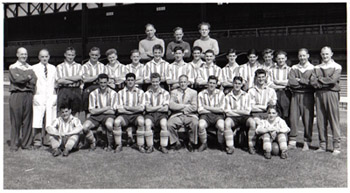 Prior to what would be a disastrous season an unusual match took place at Roker Park, between the whites and the stripes. 12 August 1953 saw 15,000 fans turn up to watch an exhibition game in which the first team attack and the reserve defence (whites) lined up against the reserve attack and first team defence (stripes).